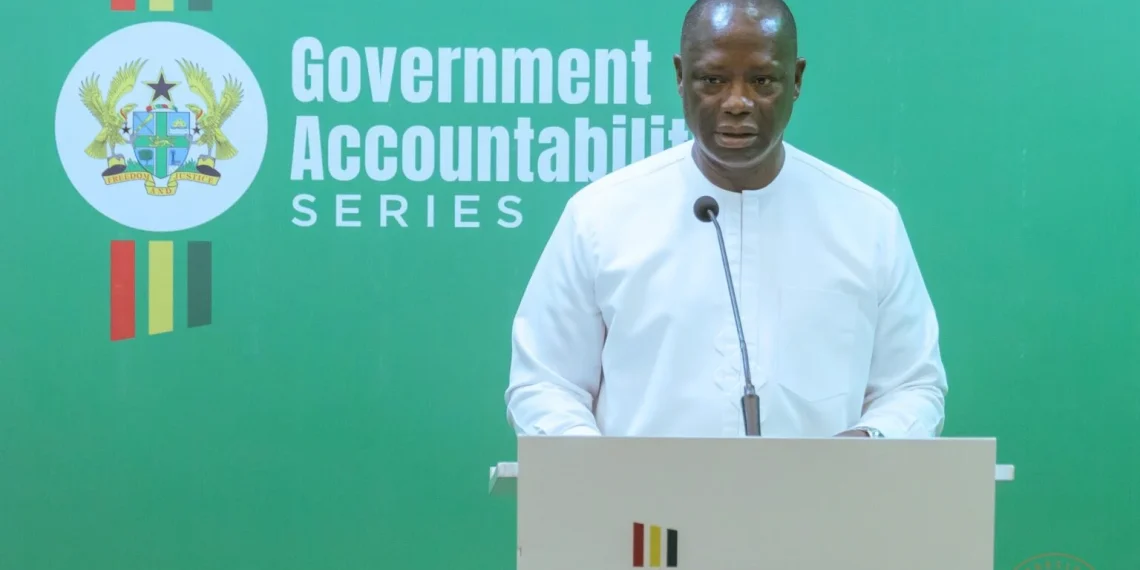
Minister for Lands and Natural Resources, Emmanuel Armah-Kofi Buah, has unveiled sweeping policy and legislative reforms aimed at intensifying Ghana’s fight against illegal mining (galamsey), describing them as bold measures that will strengthen environmental protection, empower mining communities and modernise the country’s mining regulatory framework.
Speaking at the Government Accountability Series on Wednesday July 15, 2026, he announced that Cabinet has approved a revised Minerals and Mining Policy and endorsed a new Minerals and Mining Bill to replace key provisions of the Minerals and Mining Act, 2006 (Act 703), which has governed the sector for nearly two decades.
The minister said the reforms were designed to address long-standing challenges in the mining industry, particularly illegal mining, speculative acquisition of mining concessions, weak community participation and limited local value addition.
He stressed that government’s approach to tackling galamsey goes beyond law enforcement and includes policy, legal and institutional reforms to ensure responsible mining while protecting the country’s natural resources.
“The policy seeks to indigenize mining by strengthening local content through domestic value addition to minerals, improve linkages to the manufacturing industry and deal decisively with the menace of illegal mining and the protection of our environment,” Mr Buah said.
According to him, the revised Minerals and Mining Policy, which replaces the 2014 policy framework, seeks to create a mining sector that delivers greater economic benefits to Ghanaians while ensuring the sustainable exploitation of mineral resources.
The policy prioritises local participation in mining, domestic processing of minerals, stronger linkages between the extractive and manufacturing sectors, and enhanced environmental protection measures.
New law to strengthen mining governance
Mr Buah said the Minerals and Mining Act, 2006 (Act 703), has also undergone a comprehensive review following extensive consultations with stakeholders across the mining industry.
The revised bill has been approved by Cabinet and will be forwarded to Parliament for consideration and approval.
He described the proposed legislation as an updated and forward-looking legal framework capable of addressing the evolving challenges confronting Ghana’s mining industry.
“The revised bill provides an updated, coherent and forward-looking legal regime to ensure that mining contributes immensely to national development,” he stated.
According to the minister, one of the most significant reforms contained in the proposed legislation is the establishment of District Mining Committees to increase community involvement in the licensing process.
He said communities that host mining operations have for years remained largely excluded from decisions affecting their lands despite bearing the environmental and social consequences of mining.
The new system, he explained, will require prospective licence holders to first engage host communities before applications are processed by the relevant state agencies.
“We are going to finally empower communities where the mining takes place by saying that anybody who is going to be engaged in licences will begin the process with the communities. They will give their recommendations before you come to Accra,” Mr Buah said.
He said the measure would improve transparency, reduce conflicts and ensure that local concerns are considered before mining licences are granted.
Government targets licence speculation
The minister also announced major changes to Ghana’s mineral licensing regime, saying government is determined to eliminate speculative practices that have prevented genuine investment in mineral exploration.
Under the proposed law, reconnaissance and prospecting licences will be abolished and replaced with exploration licences valid for five years.
Mr Buah explained that the current licensing system has allowed some individuals and companies to acquire large mining concessions without undertaking meaningful exploration activities.
“For a long time the industry has been occupied by speculating. You have simply taken licences and occupied the whole ground. We want serious investments that are focused on the serious business of exploration operations,” he said.
He indicated that companies would now be required to undertake clearly defined work programmes within specified timelines.
Failure to meet those obligations, he warned, could result in the withdrawal of licences.
“There are timelines in this operation. You have your work programme and then we will extend it for about five years. Over five years, if you cannot act, we will take it from you,” the minister added.
Host communities to negotiate development priorities
Another key reform announced by Mr Buah relates to Community Development Agreements between mining companies and host communities.
He said the revised law would ensure that communities have greater influence over projects undertaken by mining companies as part of their corporate social responsibility obligations.
Rather than allowing mining companies to unilaterally decide what projects to undertake, communities will negotiate directly with companies to determine their priority development needs.
“It is no longer going to be the choice of a mining company who will give them some water. The community will negotiate their critical needs and that will be agreed voluntarily by the mining company and the community,” he stated.
The minister said the reform would promote fairness, improve accountability and ensure that mining activities translate into meaningful socio-economic development for host communities.
Flexible royalties to sustain the industry
Mr Buah also disclosed that government is introducing greater flexibility into Ghana’s mining fiscal regime to support both state revenue mobilisation and the long-term sustainability of mining companies.
He explained that royalty rates could increase during periods of high mineral prices or production booms, allowing government to maximise revenue.
Conversely, rates could be reduced during downturns to ease financial pressure on mining companies, maintain production and protect jobs.
“The regulations are a win-win not only for the people of Ghana but for the industry as well. We want to ensure continuity of operation at all times while government also takes advantage when there’s a boom,” he said.
Blue Water Guards expanded
Highlighting progress in the fight against illegal mining, Mr Buah announced that government has strengthened the Blue Water Guards initiative through the recruitment, training and deployment of an additional 452 personnel.
The latest deployment brings the total number of Blue Water Guards operating across eight regions to 2,069.
The initiative, he said, remains one of government’s most important interventions in protecting rivers and other water bodies from destruction by illegal mining.
“The Blue Water Guards is a very important part of this fight,” he emphasised.
The minister added that government is also implementing mercury pollution abatement programmes to reduce contamination associated with illegal mining and restore degraded water bodies.
He commended the Blue Water Guards for their role in safeguarding the country’s water resources and supporting broader environmental protection efforts.
Mr Buah expressed confidence that the revised mining policy and proposed legislative reforms would transform Ghana’s mining sector by strengthening regulation, increasing community participation, promoting responsible investment and enhancing government’s campaign against galamsey.
He said once approved by Parliament, the new legal framework would provide the tools needed to ensure that Ghana’s mineral resources are exploited responsibly while delivering greater benefits to citizens and protecting the environment for future generations.
CREDIT: MAVIS FANTEVI