


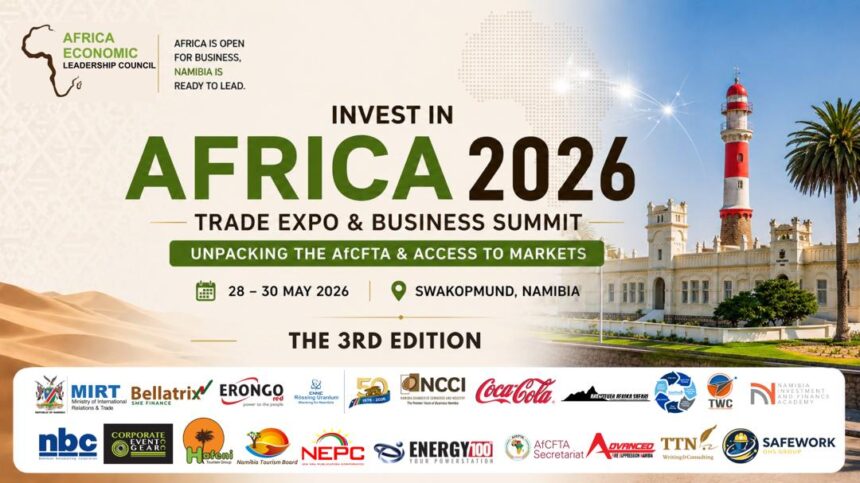
SWAKOPMUND, Namibia — The Africa Economic Leadership Council (AELC) has renewed calls for stronger intra-African trade and the free movement of goods and services across the continent, urging governments, businesses and entrepreneurs to fully embrace opportunities under the African Continental Free Trade Area (AfCFTA).
Speaking at the third edition of the Invest in Africa Trade Expo and Business Summit 2026 in Swakopmund, AELC Co-founder and Summit Director, Heinrich Hafeni, said Africa must work towards increasing trade among African countries from the current 18 percent to more than 50 percent by 2063.
“The AfCFTA seeks to increase trade within Africa from the current 18 percent to about 53 percent by the year 2063,” Hafeni said.
He noted that Africa continues to lag behind regions such as Europe and the Americas in terms of intra-regional trade and stressed the need for African countries to add value to their natural resources while fostering greater economic cooperation.
“Africa must move beyond exporting raw materials and focus on value addition, while encouraging entrepreneurs across the continent to collaborate and build stronger economic cohesion,” he said.
Hafeni explained that the Africa Economic Leadership Council was established in 2021 following the operationalisation of the AfCFTA agreement to create awareness and advocate for opportunities available under the continental trade framework.
According to him, the private sector has a critical role to play in driving implementation through conferences, exhibitions and strategic business engagements.
The summit brought together government officials, private sector leaders, diplomats, SMEs and entrepreneurs from across Africa to discuss trade, investment, industrialisation, logistics and the movement of African goods and services.
Hafeni said this year’s gathering placed significant emphasis on helping ordinary Africans understand how they can benefit from the AfCFTA.
“We want small traders, SMEs and entrepreneurs to understand the opportunities available under AfCFTA and how they can access larger African markets,” he said.
He also highlighted the need for stronger support systems, including cooperatives, improved logistics networks and access to funding, to help small businesses compete across borders.
The event attracted delegates from several African countries, including Tanzania, Botswana, Lesotho, South Africa and Ghana, as well as nearly ten African ambassadors.
Calling for greater regional integration, Hafeni urged African governments to improve the treatment of travelers at immigration points across the continent.
“Africa must remain open for business and committed to economic unity without borders,” he said.
Meanwhile, AELC Co-founder and Director of the Invest in Africa Trade Expo and Summit 2026, Percy Maropedi-Koji, described the AfCFTA as a transformative opportunity that requires practical implementation.
“The AfCFTA policy presents a major opportunity for Africans to trade among themselves. The focus now must be on implementation rather than discussions,” Maropedi-Koji said.
He called on governments to support initiatives that ease movement across African countries through digitised travel systems and stronger funding mechanisms for entrepreneurs and investors.
Maropedi-Koji said recent global economic disruptions, including challenges affecting oil and gas imports, underscore the urgency of strengthening Africa’s internal trade systems.
“Recent global shocks have shown why Africa must reduce dependency on external markets and strengthen its own trade networks,” he said.
He added that successful implementation of AfCFTA initiatives could create jobs, strengthen economies and unlock sustainable growth across the continent.
Participants at the summit expressed optimism that stronger collaboration between governments, businesses and entrepreneurs will help unlock Africa’s vast trade potential and advance the vision of an economically integrated and borderless continent.
Source: Nana Achiaa Aboagye