


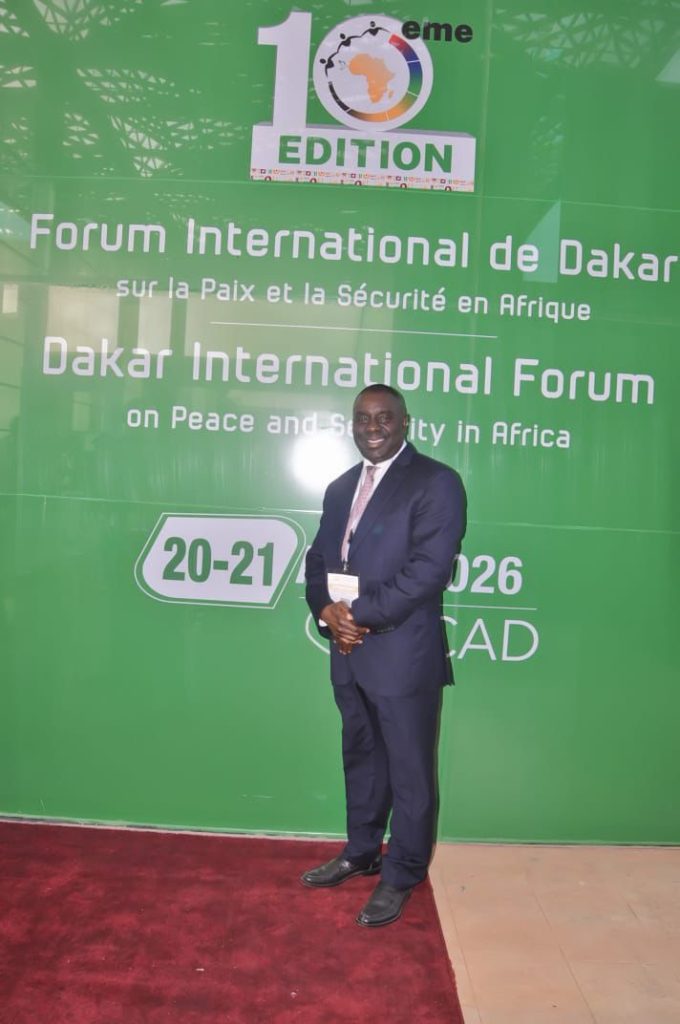
Source: Ebenezer De-Gaulle
Civil society organisations and non-state actors must play a central role in addressing West Africa’s growing security challenges, according to Rasheed Seidu Inusah, Chief Executive Officer of the Centre for Intelligence and Security Analysis.
Speaking at the 10th edition of the Dakar International Forum on Peace and Security in Africa in Dakar, Ambassador Inusah called for stronger regional cooperation and more inclusive strategies to counter evolving threats across the subregion.
He warned that terrorism and instability can no longer be tackled solely through military interventions led by states, advocating instead for a broader, integrated approach that incorporates communities and grassroots actors.
“Civil society and non-state actors are neither substitutes for state authority nor marginal participants in security governance,” he said. “They represent a strategic layer within a broader, integrated security framework.”
Growing Threats Across the Region
Ambassador Inusah highlighted the continued southward spread of extremist activity from the Sahel into coastal countries such as Ghana, Togo, Benin, and Côte d’Ivoire.
He pointed to armed groups linked to Jama’at Nusrat al-Islam wal-Muslimin and Islamic State Sahel Province, noting that they are exploiting porous borders and weak governance structures to expand their reach.
Key hotspots such as the Liptako-Gourma region and the Lake Chad Basin remain particularly vulnerable, with increasing risks of spillover into coastal states.
He also cited shifting geopolitical dynamics, including the emergence of the Alliance of Sahel States and evolving relations within the Economic Community of West African States, as complicating regional security coordination.
Civil Society as a Frontline Actor
Against this backdrop, Ambassador Inusah stressed that civil society groups—ranging from religious leaders and traditional authorities to youth and women’s organisations—are often the most trusted actors within local communities.
“These groups contribute to early warning systems, mediate conflicts, and help counter radicalisation,” he said, adding that terrorist expansion often thrives where governance gaps and social grievances intersect.
He warned that overreliance on military responses could deepen mistrust between citizens and the state, while inclusive approaches can strengthen resilience and build confidence in public institutions.
Toward an Integrated Security Framework
Ambassador Inusah called for civil society to be fully integrated into a wider security ecosystem that includes governments, the private sector, humanitarian organisations, and research institutions.
He pointed to initiatives such as the Accra Initiative as examples of emerging models that combine military coordination with community engagement.
However, he cautioned that the growing role of non-state actors must be supported by strong governance frameworks to ensure accountability, protect human rights, and maintain state authority.
Call for Action
The CISA Ghana CEO urged policymakers to institutionalise civil society participation in early warning and conflict prevention systems, strengthen collaboration across sectors, and invest in vulnerable border communities.
He also emphasised the need to protect civic space and embed inclusive approaches within frameworks of regional bodies such as ECOWAS and the African Union.
A Shift in Security Thinking
As the Dakar Forum marked its 10th anniversary, discussions reflected a broader shift in Africa’s approach to security—from predominantly military responses to more comprehensive strategies that prioritise both state capacity and societal resilience.
“An effective response to contemporary security challenges must be comprehensive,” Ambassador Inusah said. “It should combine capable state institutions, strong regional cooperation, and inclusive approaches that reinforce trust between governments and the communities they serve.”
He concluded that long-term stability in West Africa will ultimately depend not only on military strength, but on the level of trust between states and their citizens—an area where civil society plays a decisive role.