

Overview
Ovarian cysts are fluid-filled sacs or pockets in an ovary or on its surface. Women have two ovaries — each about the size and shape of an almond — on each side of the uterus. Eggs (ova), which develop and mature in the ovaries, are released in monthly cycles during the childbearing years.
Many women have ovarian cysts at some time. Most ovarian cysts present little or no discomfort and are harmless. The majority disappears without treatment within a few months.
However, ovarian cysts — especially those that have ruptured — can cause serious symptoms. To protect your health, get regular pelvic exams and know the symptoms that can signal a potentially serious problem.
Symptoms
Most cysts don’t cause symptoms and go away on their own. However, a large ovarian cyst can cause:
- Pelvic pain — a dull or sharp ache in the lower abdomen on the side of the cyst
- Fullness or heaviness in your abdomen
- Bloating
When to see a doctor
Seek immediate medical attention if you have:
- Sudden, severe abdominal or pelvic pain
- Pain with fever or vomiting
If you have these signs and symptoms or those of shock — cold, clammy skin; rapid breathing; and lightheadedness or weakness — see a doctor right away.
Causes
-
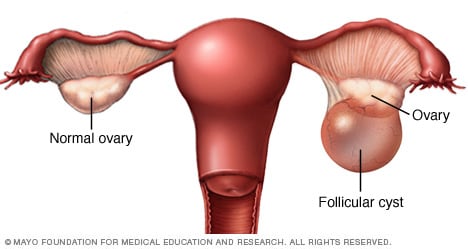
Follicular cyst
-
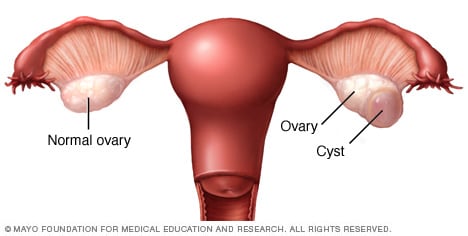
Corpus luteum cyst
Most ovarian cysts develop as a result of your menstrual cycle (functional cysts). Other types of cysts are much less common.
Functional cysts
Your ovaries normally grow cyst-like structures called follicles each month. Follicles produce the hormones estrogen and progesterone and release an egg when you ovulate.
If a normal monthly follicle keeps growing, it’s known as a functional cyst. There are two types of functional cysts:
- Follicular cyst. Around the midpoint of your menstrual cycle, an egg bursts out of its follicle and travels down the fallopian tube. A follicular cyst begins when the follicle doesn’t rupture or release its egg, but continues to grow.
- Corpus luteum cyst. When a follicle releases its egg, it begins producing estrogen and progesterone for conception. This follicle is now called the corpus luteum. Sometimes, fluid accumulates inside the follicle, causing the corpus luteum to grow into a cyst.
Functional cysts are usually harmless, rarely cause pain, and often disappear on their own within two or three menstrual cycles.
Other cysts
Types of cysts not related to the normal function of your menstrual cycle include:
- Dermoid cysts. Also called teratomas, these can contain tissue, such as hair, skin or teeth, because they form from embryonic cells. They’re rarely cancerous.
- Cystadenomas. These develop on the surface of an ovary and might be filled with a watery or a mucous material.
- Endometriomas. These develop as a result of a condition in which uterine endometrial cells grow outside your uterus (endometriosis). Some of the tissue can attach to your ovary and form a growth.
Dermoid cysts and cystadenomas can become large, causing the ovary to move out of position. This increases the chance of painful twisting of your ovary, called ovarian torsion. Ovarian torsion may also result in decreasing or stopping blood flow to the ovary.
Your risk of developing an ovarian cyst is heightened by:
- Hormonal problems. These include taking the fertility drug clomiphene (Clomid), which is used to cause you to ovulate.
- Pregnancy. Sometimes, the cyst that forms when you ovulate stays on your ovary throughout your pregnancy.
- Endometriosis. This condition causes uterine endometrial cells to grow outside your uterus. Some of the tissue can attach to your ovary and form a growth.
- A severe pelvic infection. If the infection spreads to the ovaries, it can cause cysts.
- A previous ovarian cyst. If you’ve had one, you’re likely to develop more.
Complications
Some women develop less common types of cysts that a doctor finds during a pelvic exam. Cystic ovarian masses that develop after menopause might be cancerous (malignant). That’s why it’s important to have regular pelvic exams.
Infrequent complications associated with ovarian cysts include:
- Ovarian torsion. Cysts that enlarge can cause the ovary to move, increasing the chance of painful twisting of your ovary (ovarian torsion). Symptoms can include an abrupt onset of severe pelvic pain, nausea and vomiting. Ovarian torsion can also decrease or stop blood flow to the ovaries.
- Rupture. A cyst that ruptures can cause severe pain and internal bleeding. The larger the cyst, the greater the risk of rupture. Vigorous activity that affects the pelvis, such as vaginal intercourse, also increases the risk.
More Information
Prevention
Although there’s no way to prevent ovarian cysts, regular pelvic examinations help ensure that changes in your ovaries are diagnosed as early as possible.
Be alert to changes in your monthly cycle, including unusual menstrual symptoms, especially ones that persist for more than a few cycles. Talk to your doctor about changes that concern you.