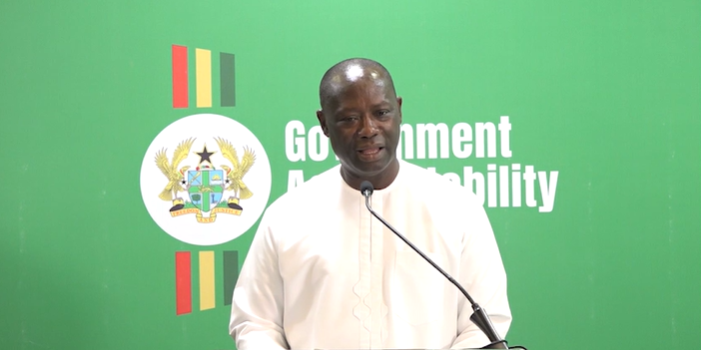
The government is planning a more flexible mining royalty regime that will allow the state to benefit more during periods of high mineral prices while reducing pressure on mining companies during economic downturns, Lands and Natural Resources Minister Emmanuel Armah-Kofi Buah has announced.
The minister said the proposed changes are part of broader reforms aimed at creating a more balanced relationship between government and mining companies, ensuring the sector remains profitable while delivering greater returns to the Ghanaian economy.
Speaking at the Government Accountability Series, Mr Armah-Kofi Buah said the new approach would prevent mining companies from collapsing during difficult periods while allowing government to take advantage of increased revenues when global commodity markets perform strongly.
He explained that the current system must be adjusted to reflect changing realities in the mining industry, where commodity prices often rise and fall sharply.
“We want to ensure continuity of operation at all times while government also takes advantage when there’s a boom,” the minister said.
According to him, the proposed framework will allow royalty rates to respond to market conditions.
During periods of high commodity prices and increased production, government could increase its share of revenue from mining activities.
However, when prices decline and companies face financial difficulties, royalty rates could be reduced to ease pressure on operations, protect investments and safeguard jobs.
“The regulations are a win-win not only for the people of Ghana but for the industry as well,” Mr Buah stated.
He said the objective is to create a sustainable mining environment where government revenue mobilisation does not come at the expense of the survival of mining companies.
The minister explained that maintaining continuous mining operations is critical because disruptions in production can affect employment, local economies and government revenue.
“Reducing rates during downturns will prevent negative cash flow, encourage continuous operations and guarantee job security,” he added.
The proposed fiscal changes form part of a wider review of Ghana’s mining sector regulations, including amendments to the Minerals and Mining Act, 2006 (Act 703).
Mr Buah said the revised legislation, which has been approved by Cabinet and is expected to be presented to Parliament, is designed to provide a modern legal framework that ensures mining contributes more significantly to national development.
“The revised bill provides an updated, coherent and forward-looking legal regime to ensure that mining contributes immensely to national development,” he said.
Beyond fiscal reforms, the minister noted that government is also pursuing measures to increase local participation in mining, promote domestic value addition and strengthen links between mining and manufacturing.
He said the revised Minerals and Mining Policy, which has also been approved by Cabinet, will focus on ensuring that Ghana gains more value from its mineral resources instead of relying mainly on the export of raw minerals.
“This policy seeks to indigenize mining by strengthening local content through domestic value addition to minerals and improve linkages to the manufacturing industry,” Mr Buah stated.
Industry analysts have long argued that Ghana’s mining sector must move beyond revenue collection and focus on creating jobs, supporting local businesses and developing downstream industries.
The minister said the reforms are intended to achieve that balance by creating an environment where investors can operate sustainably while the country receives a fair share of its mineral wealth.
He added that the government’s broader mining reforms will also address challenges such as speculative holding of mining concessions, environmental degradation and limited community benefits.
The proposed changes to the mining fiscal regime are expected to form part of discussions as the revised Minerals and Mining Bill moves to Parliament for consideration.
CREDIT: MAVIS FANTEVI