
















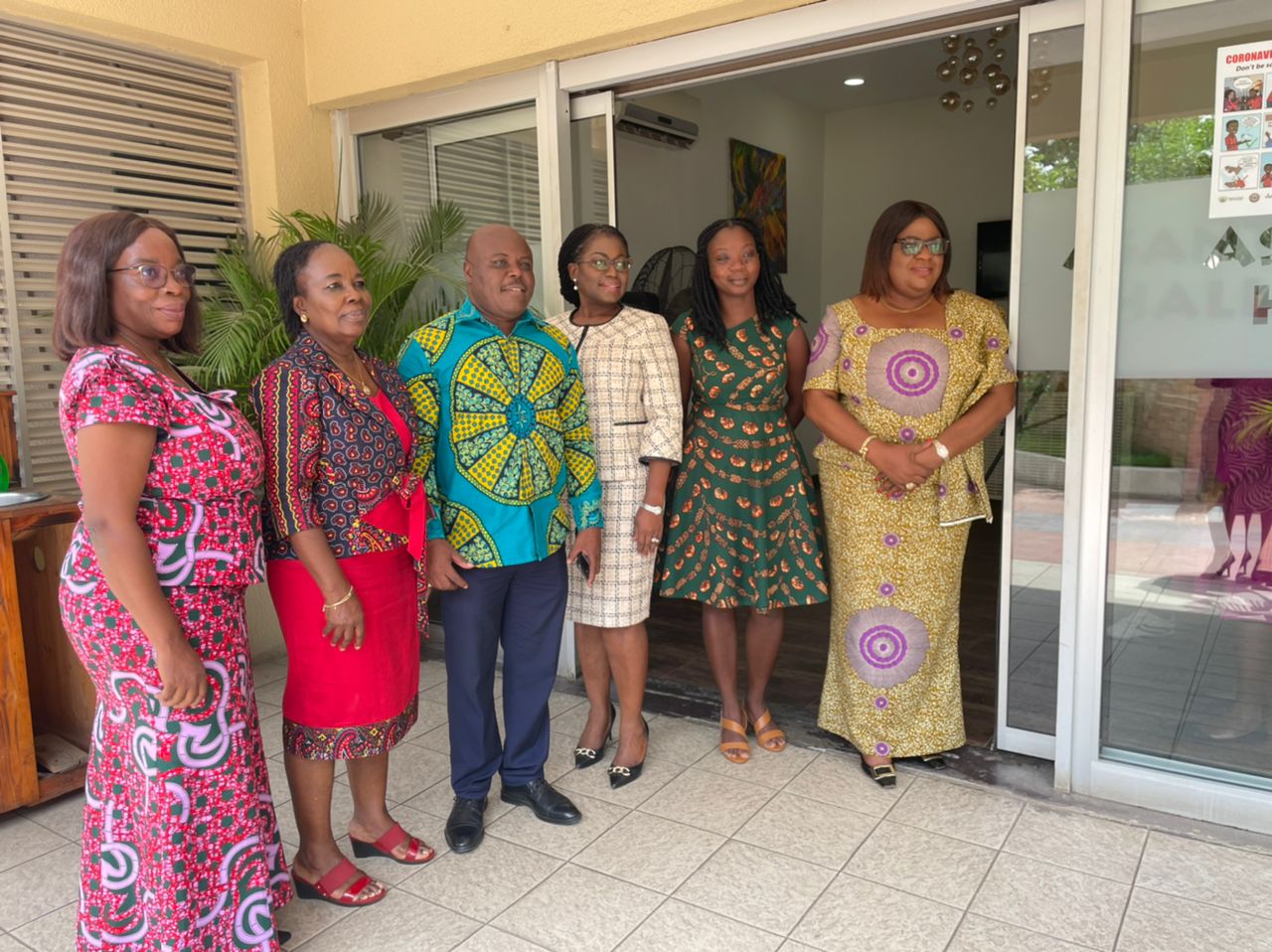
As part of its efforts to promote women’s economic rights and security in Ghana, NETRIGHT in partnership with the Graca Machel Trust and Crossroads International has held a national policy dialogue on the theme ‘Gendered Covid-19 Impacts on Women-owned Micro, Small and Medium Enterprises (MSMEs) and Women’s Financial Inclusion in a Digital Economy’ in Accra.
The dialogue which aimed at assessing the impact of COVID-19 on women-owned businesses and to provide key recommendations to inform policy direction on eliminating barriers that inhibit their growth, brought together over fifty stakeholders drawn from women-owned enterprises, government and private sector institutions, financial institutions, civil society organizations, academia, trade unions and associations as well as women’s rights organizations (WROs) across Ghana.
Representing the Vice President of Ghana Dr. Mahamudu Bawamia as the keynote speaker for the event was the Minister for Public Enterprises and Member of Parliament of Effia constituency in the Western Region Hon. Joseph Cudjoe.
He urged stakeholders to leverage technology by finding innovative ways to enhance women’s businesses and called on NETRIGHT to “Work with data platforms to find markets to enable women to transact business.” Hon Cudjoe suggested that signing agreement with government agencies such as Ghana Post would enable women to have access to its micro-grant insurance products to boost their small-scale businesses.
In her remarks, the 2nd Deputy Governor of the Bank of Ghana Mrs. Elsie Addo Awadzi noted that sadly, there is a huge gap when it comes to women’s access to financial support and many interventions introduced to alleviate women from post-covid-19 loses tended to benefit men as many women lack the requisite skills and technical know-how to access such grants and to even use digital service platforms such as mobile money to transact business.
Explaining how women can realize their potential to contribute to the economy in a more resilient way, the 2nd Deputy Governor encouraged stakeholders to find efficient ways to ensure that women from the early stages of their lives can develop their entrepreneurial skills.
The Interim Country Manager for Crossroads International, Gifty Volimkarime Kuug on her part said “we do realize that digital innovation is one of the components that women are very disadvantaged and excluded and in selecting our partners for our 2022 to 2027 women economic empowerment program, we were very deliberate in our search and we are happy to have NETRIGHT as one of our partners implementing this project.”
The opening session of the Dialogue had presentations made on ‘covid-19 measures and its gendered impact on women’s livelihoods’ and ‘prospects and challenges for women’s financial inclusion in promoting an inclusive digital economy’ by Prof. Abena D. Oduro of the Department of Economics at the University of Ghana and Mrs. Clarrisa Kudowor, the Assistant Director of Payment System at the Bank of Ghana respectively.
The presentations which were based on rigorous studies done on post covid-19 impact on women-owned businesses showed that increased household chores took away time women could have spent on business activities and even those who took to social media platforms to do business could not thrive due to lack of funds to promote their businesses online and poor internet connectivity.
It was highly recommended that if women can effectively participate in labour programs, then they must be relieved of the burden of care and excessive household chores. Also, addressing challenges with internet connectivity by designing Digital Financial Services (DFS) that solve problems for women and continuous financial literacy to build their capabilities and autonomy to use DFS will empower them.
Read Also: Dismissal of review application on Dep. Speakers’ right to vote not surprising – Inusah Fuseini
To widen the scope of the dialogue, there was a panel discussion session moderated by Pro. Emerita Takyiwaa Manuh, which featured among other panelists, two women entrepreneurs who shared how covid-19 impacted their work. The Executive Director of Widows and Orphans Movement (WOM) Fati Abigail Abdulai revealed that most women lost their start-up capitals, and the situation was even worse for single mothers who had no support systems.
The CEO of mSimps a creative enterprise, Mabel Simpson on her part indicated that she had to diversify into making of nose masks and increased production by engaging other seamstresses who had fallen out of business during the lockdown period. According to Fati and Mabel, although they applied for the Corona Virus Alleviation Programme – Business Support Scheme (CAP-BuSS) introduced by government to alleviate MSMEs from covid-19 loses, they were not given the grant.
The Coordinating Director (Technical) at the Ministry Finance Eva Esselba Mends added that the covid-19 pandemic has shown that many women are poverty-stricken and need support.She noted that Ghana as a country needs to boost its value addition to reduce the rate of importation of goods and we need to support women entrepreneurs with these skills.
The NETRIGHT Convenor, Prof. Akosua Darkwah said the last Mastercard Index for Women Entrepreneurs showed that about “40% of our women are entrepreneurs and yet we do not see the full benefit of the work that they do, they are not able to grow their enterprises in the way that they should, in the ways that will generate income for not just themselves but their families as a whole, that was the situation even before covid, now that covid has hit us, we are going to hear about how that has made the situation even worse.”
Prof. Darkwah reiterated NETRIGHT’s commitment to reaching out to as many women as possible and making sure that they are not just working but earning incomes for themselves as well as their families.
She indicated that NETRIGHT and its partners will continue to deepen advocacy on women’s financial inclusion by engaging the state to implement important policy recommendations which would be generated from the dialogue to improve women’s lives adding that “if our women’s lives improve, all of us improve as well.”
Ghana | Atinkaonline.com | Joyce Hilda Efia Aboagye