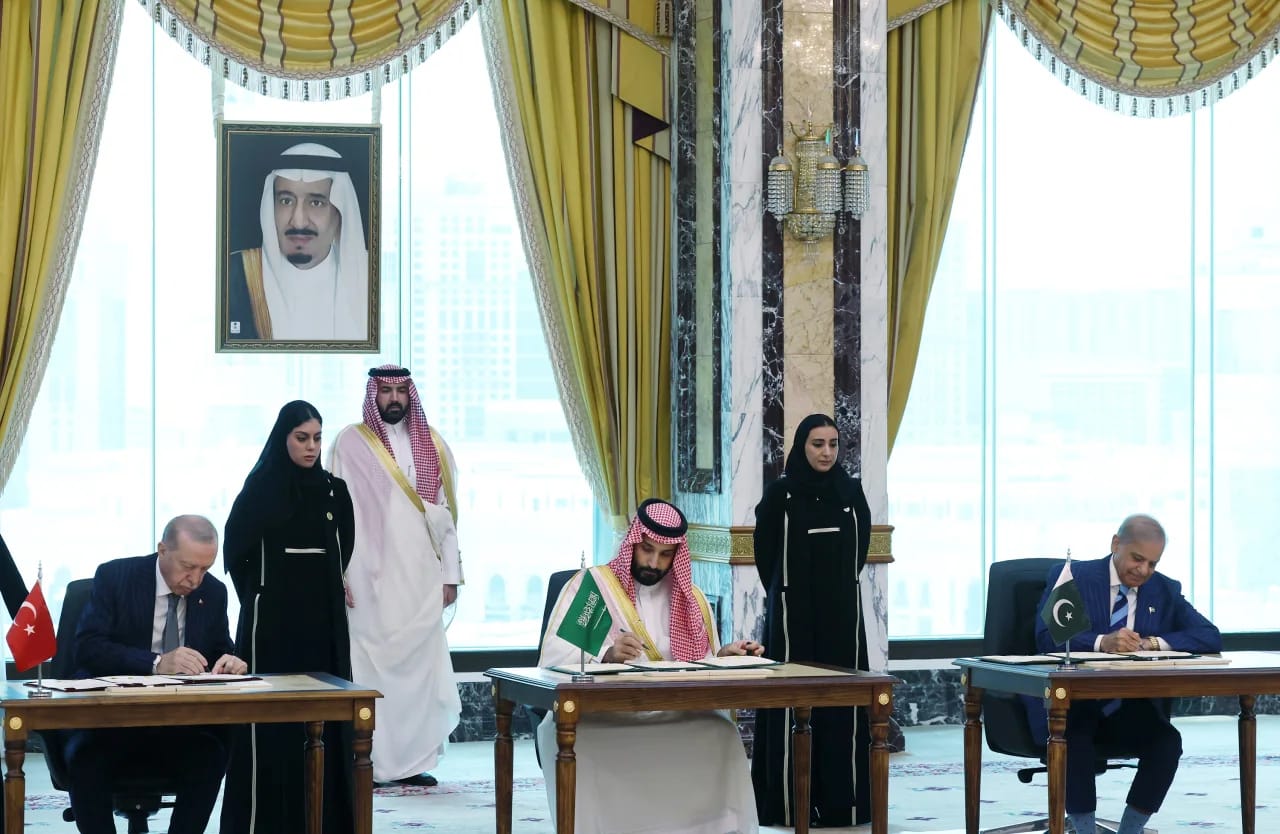
Saudi Arabia, Turkey and Pakistan have signed a landmark mutual defence agreement that commits each country to come to the aid of the others if any one of them is attacked, marking a significant shift in regional security cooperation amid growing instability in the Middle East.
The trilateral pact, signed on Friday August 7, 2026, in the Saudi holy city of Mecca, states that an attack against any of the three nations “shall be regarded as an attack against them all,” mirroring the principle of collective defence that underpins the North Atlantic Treaty Organization (NATO).
In a joint statement issued after the signing ceremony, the three countries said the agreement is aimed at strengthening collective deterrence against external aggression while deepening military and strategic cooperation.
The statement described the pact as being “intended to strengthen collective deterrence against any act of aggression” and said it would further enhance “all aspects of defence cooperation among the three states.”
The agreement was reached following high-level talks involving Turkish President Recep Tayyip Erdoğan, Saudi Crown Prince Mohammed bin Salman and Pakistani Prime Minister Shehbaz Sharif.
The three leaders underscored the importance of closer defence collaboration at a time of heightened geopolitical uncertainty across the region.
The signing comes as Saudi Arabia faces mounting security threats, particularly from the Iran-backed Houthi rebels in neighbouring Yemen.
The kingdom has expressed growing concerns over the possibility of further attacks on its territory as regional tensions continue to escalate.
The defence pact is expected to strengthen the military coordination of the three nations by improving intelligence sharing, defence planning, joint training exercises and strategic cooperation.
While specific operational details of the agreement have not yet been made public, the collective defence clause signals a major commitment by each country to support the others in the event of external aggression.
The choice of Mecca as the venue for the signing carries deep political and religious significance.
Beyond being Saudi Arabia’s most revered city, Mecca is the birthplace of the Prophet Mohammed and the spiritual centre of Islam, making the agreement symbolic of unity among three influential Muslim-majority nations.
The pact also brings together countries with considerable strategic importance. Saudi Arabia remains one of the world’s leading oil exporters and a key player in global energy markets, while Pakistan is the only Muslim-majority country possessing nuclear weapons. Turkey, meanwhile, has one of NATO’s largest armed forces and has expanded its defence industry and regional influence in recent years.
In their joint statement, the leaders said the agreement is “guided by the longstanding historical ties among the three states, based on the enduring bonds of brotherhood and Islamic solidarity that unite them.”
They added that the pact builds on “their shared strategic interests and longstanding defence cooperation,” reflecting a commitment to strengthening regional stability through closer security partnerships.
The agreement is expected to reshape the security landscape in the Middle East and South Asia, with analysts closely watching how it may influence regional alliances and the strategic calculations of neighbouring countries.
The pact also comes at a time when conflicts and geopolitical rivalries continue to intensify across the wider region, raising the importance of collective security arrangements among key regional powers.
SOURCE: CNN