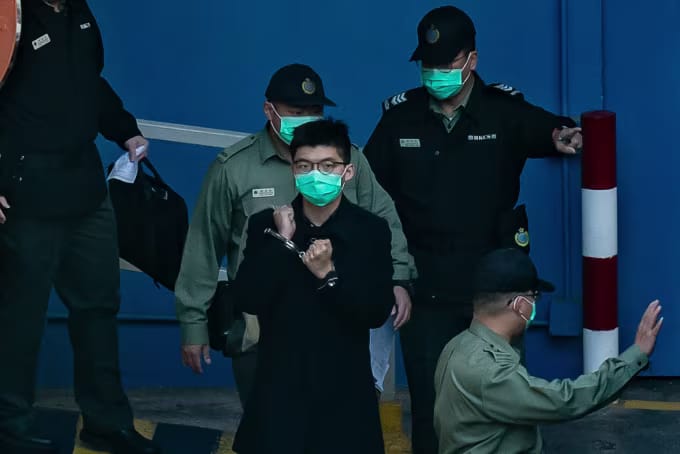
Hong Kong pro-democracy activist Joshua Wong is facing the possibility of several more years in prison after pleading guilty to a second national security charge in Hong Kong.
Wong, 29, appeared before the High Court on Wednesday and admitted to conspiring with other activists to lobby foreign governments to impose sanctions on China and Hong Kong.
The case stems from a campaign launched in 2020, known as “International Battlefront,” which prosecutors said sought to persuade countries, particularly the United States, to impose sanctions on Chinese and Hong Kong officials.
Prosecutors told the court that Wong and other activists had campaigned for US legislation that would allow Washington to sanction Hong Kong and China.
The campaign involved social media activity and meetings with American politicians, including former US House Speaker Nancy Pelosi and then-Senator Marco Rubio.
According to prosecutors, the campaign continued after Beijing imposed the National Security Law on Hong Kong in June 2020. The United States subsequently sanctioned more than a dozen Hong Kong and Chinese officials.
Wong is already serving a four-year and eight-month prison sentence after pleading guilty in the landmark “47 case,” involving an unofficial opposition primary held in 2020.
He was expected to be released in January, but the latest case could keep him behind bars for much longer.
The national security offence carries a maximum sentence of life imprisonment, although prosecutors acknowledged that Wong could face a sentence of up to 10 years in this case.
During mitigation, Wong’s lawyer, Derek Chan, asked the court to reduce the potential sentence by half.
Chan said Wong had spent the past six years in prison on various charges and had pleaded guilty in each case.
“He has had a lengthy opportunity to reflect on his action, to reflect on the path that he took,” Chan told the court, urging the judge to impose a sentence that would leave Wong with “hope and a future to look forward to.”
The court adjourned sentencing to a later date.
As Wong was escorted from the courtroom, he waved to people in the public gallery and said, “Bye bye.”
Government defends prosecution
The Hong Kong government has rejected international criticism over Wong’s prosecution, insisting that freedom of expression does not extend to efforts to encourage foreign governments to impose sanctions on China or Hong Kong.
A government spokesperson said lawful free speech should not be confused with actions intended to “collude with a foreign country” to harm Hong Kong and China.
Security was tight around the court complex on Wednesday, with police officers registering and searching people seeking to attend the proceedings.
Wong’s supporters said his latest prosecution highlighted the increasingly difficult environment for political opposition in Hong Kong.
Gloria Cheng, a 32-year-old friend of Wong, said the case demonstrated the current state of affairs in the city.
Another supporter, Louis Lee, said Wong had tried to remain positive while in prison by studying, exercising and learning to play the guitar.
Lee said Wong was devastated when he learned that he had been charged with another national security offence.
“No one would like to spend another day in prison,” Lee said.
From teenage activist to jailed democracy leader
Wong first gained international attention at the age of 15 in 2012, when he helped lead protests against a proposed Chinese civic education programme in Hong Kong schools.
Two years later, he became one of the prominent faces of the Umbrella Movement, a major pro-democracy protest that occupied parts of Hong Kong for 79 days as demonstrators demanded greater democratic freedoms.
Wong later entered politics and co-founded the pro-democracy party Demosisto in 2016. However, his attempts to stand for election were repeatedly blocked.
Following Beijing’s introduction of the National Security Law in 2020, Demosisto disbanded. Its co-founder Nathan Law subsequently left Hong Kong and is now among several overseas democracy activists wanted by Hong Kong authorities.
Wong was later arrested alongside dozens of other opposition figures over the unofficial 2020 primary elections.
The case, commonly known as the “47 case,” became the largest prosecution of pro-democracy activists under Hong Kong’s national security legislation.
Most defendants pleaded guilty, while 14 were convicted following a 2024 trial and sentenced to prison terms of up to 10 years. Two defendants were acquitted.
Since the National Security Law came into force, several civil society groups have disbanded and independent media outlets have closed. Hong Kong’s legislature is now dominated by pro-Beijing lawmakers, while many prominent pro-democracy figures remain in prison or have gone into exile.
Wong’s latest guilty plea adds to a series of national security prosecutions that have significantly reshaped Hong Kong’s political landscape.