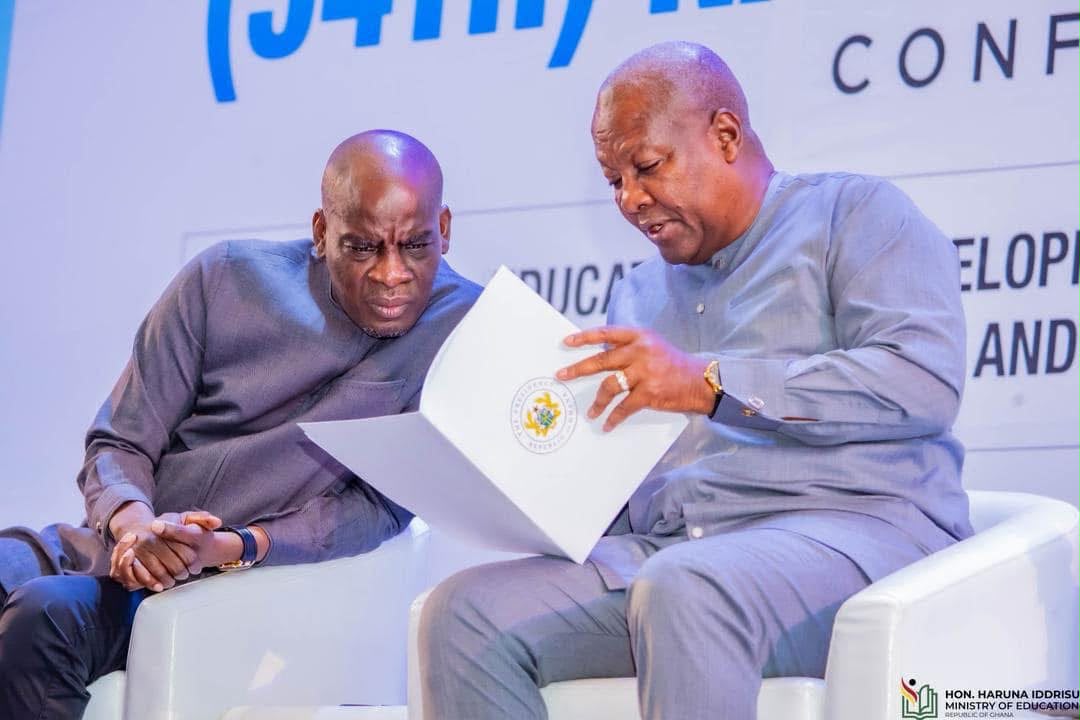
The New Patriotic Party (NPP) has challenged President John Mahama to either apologise to Ghanaians or remove Education Minister Haruna Iddrisu from office over the controversy surrounding the proposed introduction of Arabic and Chinese language studies in Ghanaian schools.
According to the NPP’s Education Sector Policy Committee, the President’s recent denial that Cabinet had approved any new policy to introduce Arabic and Chinese into Ghanaian schools has created a serious contradiction within the government.
The party said that if the Education Minister announced and pursued the policy without presidential or Cabinet approval, then President Mahama must sanction him.
However, if the Minister acted with the knowledge or authority of the President or Cabinet, the NPP said the President owes Ghanaians an apology for denying a policy it claims government institutions had already begun implementing.
The NPP cited an April 24, 2026 statement attributed to Education Minister Haruna Iddrisu, in which he reportedly announced that Chinese and Arabic would become compulsory foreign languages at the secondary school level and linked the policy to President Mahama’s vision for education.
The party further pointed to activities by the National Council for Curriculum and Assessment (NaCCA), which it said was instructed by the Education Ministry to undertake curriculum development work.
The exercise reportedly involved about 160 writers and reviewers and resulted in a revised curriculum that included Arabic and Chinese among foreign-language options.
The party also cited a September 3, 2026 teacher-training exercise organised by NaCCA, with support from the Confucius Institute at the University of Cape Coast, as further evidence that preparations for the Chinese language curriculum had advanced.
The NPP argued that these developments would reasonably have appeared to the public as legitimate government actions, particularly because the Education Minister had attributed the policy direction to the President and government institutions had been involved in its development.
The party therefore questioned the President’s subsequent assertion that there was “absolutely no new policy”, saying the statement raises concerns about policy coordination, governmental authority and communication at the executive level.
The NPP also raised questions about public expenditure associated with curriculum development, implementation preparations and teacher training. It questioned why public resources would have been committed to the process if there was no new policy.
In its concluding demand, the party said parents, teachers, school administrators and taxpayers deserve clear and consistent government communication, insisting that the matter should not simply be declared closed.
Ghana|Atinkaonline.com|Ebenezer Madugu