






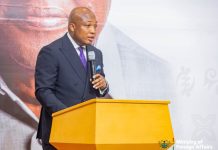


















At the National Anti-Corruption Conference held in Accra, Ghana’s Special Prosecutor, Kissi Agyebeng, stirred debate by rejecting popular calls for the publication of asset declarations by public officials.
Addressing a gathering of legal experts, civil society actors, and anti-graft advocates, the Special Prosecutor argued that such publication would do more harm than good.
“I do not and I will not add my voice to the calls for the publication of assets for public scrutiny,” he said pointedly. “In our experience, it will be unhelpful and would merely subject public officers to inordinate public curiosity and the real likelihood of reprisals against those assets.”
Instead, the Special Prosecutor advocated for a strengthened and more effective asset declaration regime. He proposed that the focus shift from public disclosure to the establishment of a robust verification and tracing system. According to him, merely filing declarations into a “repository” without checks is insufficient to ensure accountability.
He added, “A publication of who has declared or has not declared his assets, in the context of a workable asset verification and tracing model, would be sufficient to assure the integrity of the assets declaration system.”
In what he described as essential legal reforms, Kissi Agyebeng called for the introduction of a reverse onus clause in corruption-related proceedings. This would mean a presumption of corruption when individuals—public or private—are found to possess wealth or assets that far exceed their known legitimate sources of income.
“In all proceedings—civil and criminal—there should be a presumption of corruption where a person cannot satisfactorily account for resources or property disproportionate to his legitimate income,” he emphasized.
He also called for such cases, particularly involving confiscation and restraint of properties, to carry the weight of a High Court judgment, appealable only to the Court of Appeal. This, he argued, would speed up proceedings and deter the accumulation of unexplained wealth.
On the issue of inducements, the Special Prosecutor proposed that any gift offered to a public officer by someone seeking to do business with the government or a public agency should be presumed to be corrupt.
“We must deem such gifts as inducements or rewards,” he said, urging for laws that clearly establish this principle to prevent subtle forms of influence-peddling.
He concluded his address on a more philosophical note, stating that corruption is ultimately rooted in a collapse of values. He called for integrity to be embedded in Ghana’s educational system—from the basic level through to tertiary institutions—so that ethical conduct becomes a natural expectation rather than a legal obligation.
“Corruption begins where values collapse. That is why integrity must be designed into our educational system,” he noted.
Ghana|Atinkaonline.com|Ebenezer Madugu