Source: Mavis Fantevi
The Ministry of Foreign Affairs of Ghana has announced that the Republic of Ghana has entered into a new security and defence partnership with the European Union (EU), aimed at strengthening both national and regional security frameworks.
According to a press statement issued in Accra on Tuesday April 14, 2026, the agreement is designed to enhance cooperation in addressing emerging security threats while reinforcing Ghana’s overall security architecture.
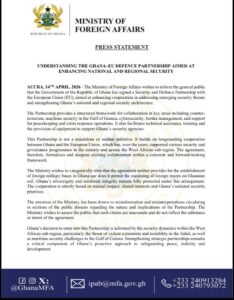
Key areas of collaboration include counter-terrorism, maritime security in the Gulf of Guinea, cybersecurity, border management, and support for peacekeeping and crisis response operations.
The Ministry explained that the partnership will also provide technical assistance, training, and equipment to bolster the operational capacity of Ghana’s security agencies.
Officials emphasized that the agreement builds on longstanding cooperation between Ghana and the EU, particularly in governance and security programmes across the West African sub-region. The new framework is expected to formalize and deepen these existing ties in a more structured and forward-looking manner.
Addressing public concerns, the Ministry categorically stated that the agreement does not allow for the establishment of foreign military bases in Ghana, nor does it permit the deployment of foreign troops on Ghanaian soil. It stressed that Ghana’s sovereignty and territorial integrity remain fully protected.
“The cooperation is strictly based on mutual respect, shared interests, and Ghana’s national security priorities,” the statement noted.
The government also dismissed circulating misinformation about the partnership, describing such claims as inaccurate and inconsistent with the agreement’s intent.
Ghana’s decision comes amid rising security challenges in the West African region, particularly the spread of violent extremism in the Sahel and increasing maritime threats in the Gulf of Guinea. Authorities say strengthening international partnerships is a critical step in safeguarding peace, stability, and development.
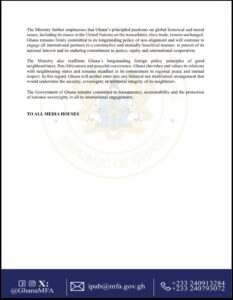
Reaffirming its broader foreign policy stance, Ghana underscored its commitment to non-alignment, peaceful coexistence, and good neighbourliness. The government also reiterated that it would not engage in any bilateral or multilateral arrangement that undermines the sovereignty of neighboring states.
The statement concluded with a pledge to uphold transparency, accountability, and national sovereignty in all international engagements.