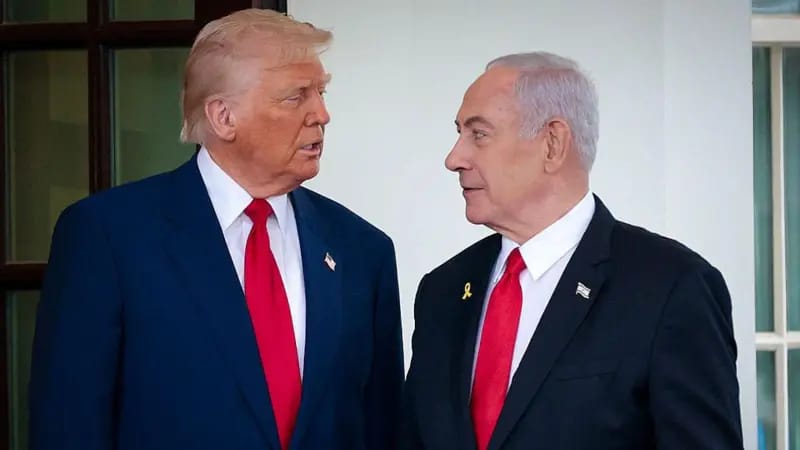
Israeli Prime Minister Benjamin Netanyahu has rejected US President Donald Trump’s 15-point peace roadmap for Gaza, insisting that Israel will not withdraw its forces from the territory until Hamas is “genuinely” disarmed.
Netanyahu announced the decision during a cabinet meeting on Sunday, marking a significant setback to the Trump administration’s efforts to secure a lasting peace agreement and establish a new political and security framework for Gaza.
“Israel rejects the 15-point document,” Netanyahu said.
He added that the Israeli military would not carry out any withdrawal until Hamas had been genuinely disarmed and would continue acting to prevent threats against Israeli forces and citizens.
The dispute centres on one of the most difficult elements of the US-backed roadmap: the timing of Hamas’ disarmament and Israel’s military withdrawal.
Under the proposal, Hamas would progressively surrender its weapons while Israeli forces would withdraw in stages, with the process subject to verification. Israel, however, is insisting that there can be no withdrawal until Hamas is fully disarmed.
The US-backed Board of Peace has defended the plan, saying its implementation would be phased, verifiable and capable of being halted if commitments are not honoured.
What is in the 15-point Gaza roadmap?
The 15-point roadmap was developed as an implementation framework for Trump’s wider Gaza peace initiative. Its provisions focus on ending the conflict, removing weapons from armed groups, establishing transitional Palestinian administration, bringing in international security forces and beginning reconstruction.
The key elements include:
- Civilian administration of Gaza
Gaza would move towards a new civilian administration designed to provide basic public services and manage day-to-day affairs independently of Hamas and other armed factions.
- Hamas excluded from governance
Hamas and other armed factions would have no role in the future political administration of Gaza.
- Complete demilitarisation
The roadmap calls for the removal of weapons and military capabilities belonging to Hamas and other armed groups, including heavy and offensive weaponry.
- Weapons decommissioning
Weapons would be permanently taken out of use through an agreed process, with the disarmament process subject to independent verification.
- Phased disarmament
Hamas’ disarmament would take place in stages rather than through a single immediate surrender, allowing progress to be verified at each stage.
- Verification mechanisms
Independent monitoring would be used to establish whether Hamas and other armed groups were fulfilling their commitments before corresponding steps by Israel were implemented.
- Phased Israeli military withdrawal
Israeli forces would gradually withdraw from Gaza as the disarmament process advances and is independently verified.
- International Stabilization Force
An International Stabilization Force would be deployed to Gaza to help maintain security, oversee the transition and support the creation of a stable post-war environment.
- Palestinian security forces
A new Palestinian police and security structure would be developed to maintain law and order and eventually assume responsibility for internal security.
- Transitional Palestinian governance
A technocratic Palestinian body would oversee Gaza’s civilian administration during the transition, with international assistance and supervision.
- Humanitarian assistance
The framework provides for the continued delivery of humanitarian assistance and the restoration of essential services to Gaza’s population.
- Reconstruction of Gaza
International support would be mobilised to rebuild Gaza’s homes, hospitals, infrastructure and other essential facilities destroyed during the war.
- International oversight
The US-backed Board of Peace would oversee key aspects of the transition, including governance, security, reconstruction and the mobilisation of international resources.
- Security linked to implementation
The roadmap ties major security steps, including Israeli withdrawal, to verified progress in Hamas’ disarmament and the establishment of alternative security arrangements.
- Reconstruction linked to stability
Long-term reconstruction and development would depend on the establishment of lasting security and political stability in Gaza.
The 15-point roadmap is therefore built around a sequence in which disarmament, Israeli withdrawal, international security arrangements and Palestinian administration are progressively implemented rather than carried out simultaneously.
Hamas says it remains committed
Despite Israel’s rejection, Hamas has indicated that it remains committed to the agreement.
A Hamas official told the BBC that the group was ready to engage seriously and responsibly in implementing the 15-point plan.
The group has, however, linked the surrender of its heavy weapons to Israel ending what it describes as all forms of aggression and withdrawing its forces from Gaza.
That position directly conflicts with Netanyahu’s insistence that Hamas must first be completely disarmed.
The disagreement has consequently created a major obstacle to implementation.
Netanyahu: No withdrawal before genuine disarmament
Netanyahu has made clear that Israel will not accept what he considers symbolic or incomplete disarmament.
He said Hamas must surrender not only heavy weapons but also lighter weapons and other military capabilities.
The Israeli prime minister has also indicated that discussions with US officials are continuing over possible ways of implementing parts of the plan.
He said some of the ideas proposed by Washington were acceptable to Israel while others were not.
“We know how to stand our ground on these matters,” Netanyahu said.
The Israeli position effectively places the burden on Hamas to demonstrate that it has surrendered its military capabilities before Israel makes further withdrawals.
US insists the plan remains alive
Despite Netanyahu’s rejection, senior officials involved in the US-backed process have said the roadmap remains operative.
Nickolay Mladenov, a senior diplomat tasked with helping implement Trump’s Gaza plan, said discussions were continuing and expressed hope for a positive outcome.
Mladenov has argued that the roadmap was deliberately designed to be verifiable and reversible, meaning that progress could be assessed at each stage rather than relying on trust alone.
He also indicated that Israel would not be required to make an irreversible withdrawal before Hamas had begun taking verifiable steps towards disarmament.
Political pressure on Netanyahu
Netanyahu’s rejection also comes amid significant pressure from members of his right-wing governing coalition.
Far-right politicians have opposed elements of the US-backed plan and have called for Israel to maintain its military presence in Gaza until Hamas is completely defeated.
National Security Minister Itamar Ben-Gvir has criticised the proposal and described it as unacceptable.
With Israeli elections approaching, Netanyahu faces the difficult task of balancing pressure from his domestic political allies with demands from Washington to keep the peace process alive.
His latest statement represents an unusually public disagreement with Trump’s Gaza initiative, although the Israeli leader has stopped short of abandoning negotiations with the United States.
Gaza faces continuing humanitarian crisis
The diplomatic dispute comes as Gaza continues to deal with the consequences of the war that began after the Hamas-led attack on southern Israel on 7 October 2023.
About 1,200 people were killed in the attack and 251 others were taken hostage.
Israel responded with a major military campaign in Gaza.
More than 73,000 people have been killed in Gaza since the beginning of the war, according to the territory’s health ministry. The United Nations considers the ministry’s figures broadly reliable.
The UN estimates that about 1.9 million people — around 90% of Gaza’s population — have been displaced.
The proposed roadmap is intended to address not only the security dispute between Israel and Hamas but also Gaza’s political future and reconstruction.
However, the disagreement over the sequence of disarmament and Israeli withdrawal remains the biggest obstacle.
For Trump’s peace initiative to succeed, the United States and its mediators will have to bridge the gap between Israel’s demand for complete Hamas disarmament before withdrawal and Hamas’ position that disarmament must be accompanied by an Israeli withdrawal and an end to military operations.
Until that issue is resolved, the implementation of the 15-point roadmap is likely to remain uncertain.
SOURCE: BBC