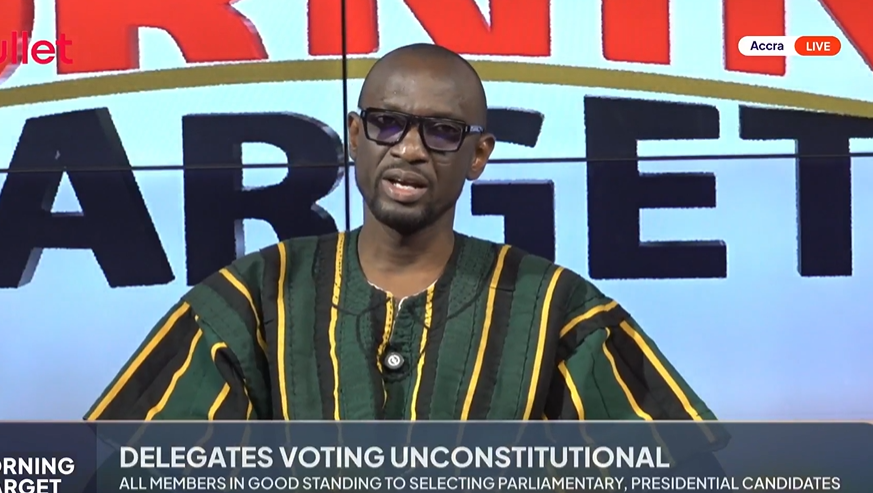
The Chief Crusader of Crusaders Against Corruption, Emmanuel Wilson, has described the Supreme Court’s ruling declaring political parties’ delegate system unconstitutional as a major opportunity to tackle the growing monetisation of Ghana’s internal party elections and strengthen democratic accountability.
Speaking on Bullet TV’s Morning Target on Thursday July 30, 2026, Wilson argued that the judgment could significantly reduce vote buying, which he said has become deeply entrenched in the country’s political processes, particularly during party primaries.
According to him, the delegate system, though originally introduced with good intentions to simplify internal party elections and encourage volunteerism, has over the years evolved into a mechanism that rewards money rather than competence.
“The decision reduces this issue of monetisation of our elections, and that, for me, is a good thing,” he stated, adding that the system has created an environment where aspirants feel compelled to distribute cash and expensive gifts to secure the support of a relatively small group of delegates.
Wilson warned that allowing money to dominate political contests poses a serious threat to Ghana’s democracy because it opens the door for individuals with questionable backgrounds to bankroll political aspirants.
He said candidates who are financially sponsored by powerful interests risk becoming beholden to those financiers once they assume public office.
“If we don’t take care, we’ll end up having drug barons sponsoring people to Parliament, and once they sponsor you, they control you,” he cautioned.
The anti-corruption campaigner also challenged the common justification by politicians that cash handed to delegates is merely “transport and nutrition” (TNT) or money meant to facilitate transportation to voting centres.
He argued that while transportation support may be legitimate when organised by political parties, candidates personally distributing money or gifts to delegates raises questions about intent.
Explaining further, he said that under criminal law, investigators must establish not only the act of giving money but also the intention behind it to determine whether it constitutes vote buying.
He further accused state investigative agencies of struggling to pursue vote-buying cases because of political interference.
According to him, institutions such as the Criminal Investigations Department (CID), the Office of the Special Prosecutor (OSP), the Commission on Human Rights and Administrative Justice (CHRAJ), and other investigative bodies often find it difficult to investigate influential politicians, particularly those within governing parties.
He argued that this lack of prosecution has emboldened politicians to openly distribute cash, refrigerators, televisions, blenders and other gifts during internal elections without fear of legal consequences.
“The only thing that has changed is that it has worsened. Before, politicians tried to do it secretly because they knew it was a crime. Today they do it publicly,” he said.
Tracing the evolution of the delegate system, Wilson said it was originally intended to reward dedicated party volunteers with the privilege of choosing parliamentary candidates, flag bearers and party executives.
However, he noted that delegates gradually realised the influence they wielded and began demanding personal benefits from aspirants, forcing politicians into intense bidding wars to secure votes.
He maintained that the practice has transformed internal party elections into contests driven largely by financial strength instead of leadership qualities.
Wilson acknowledged growing frustration among ordinary citizens who often complain that politicians fail to fulfil campaign promises after winning office.
Nevertheless, he stressed that demanding or accepting money in exchange for votes remains a criminal offence, regardless of the motivation.
He added that while both politicians and delegates share responsibility for the current state of affairs, the system has ultimately sidelined ordinary party supporters and citizens who are not delegates.
According to him, elected officials frequently concentrate on satisfying delegates rather than addressing the broader development needs of their constituencies because winning party primaries has become more critical than winning over the general electorate.
The Chief crusader believes the Supreme Court’s decision presents an opportunity for political parties to reform their internal electoral processes, reduce the influence of money in politics and restore accountability between elected leaders and the wider electorate.
CREDIT: MAVIS FANTEVI