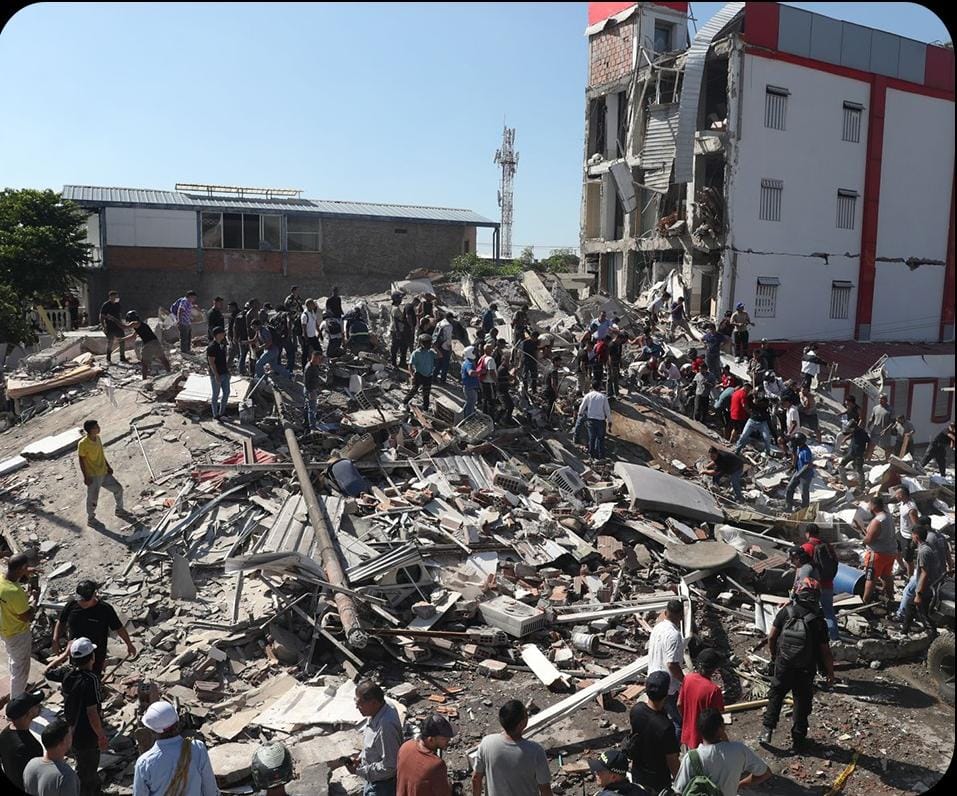
At least 132 people have died and 570 others have been injured after a powerful magnitude 7.4 earthquake struck western Colombia, triggering widespread destruction and a desperate search for survivors trapped beneath collapsed buildings.
The death toll, announced by the Colombian Association of Capital Cities, is expected to rise as emergency teams continue to comb through the rubble of damaged homes and other structures.
The earthquake struck early Monday in Colombia’s western region, with the epicentre located near San José del Palmar, an underdeveloped area about 150 miles west of the capital, Bogotá.
The tremor was strongly felt across large parts of the country, including Bogotá, where residents rushed out of homes and workplaces as buildings shook and alarms sounded.
The southwestern city of Cali has suffered significant damage, with at least 85 deaths reported by the city’s mayor, Alejandro Eder.
Eder said 188 people were still missing in Cali in an earlier update, while 37 people had been rescued.
Around 40 buildings have collapsed in the city, which has a population of about two million and is widely known as a major cultural centre and the home of Colombia’s salsa scene.
One of the most serious incidents occurred at a hospital where sections housing paediatric and neonatal patients collapsed.
Local authorities said several patients were trapped beneath the rubble, prompting rescue teams to launch urgent operations to reach those inside.
Hundreds of soldiers have also been deployed to support emergency responders and assist with rescue and security operations.
A curfew was imposed in Cali from 8 p.m. Monday until 6 a.m. Tuesday local time as authorities sought to protect residents and allow emergency teams to operate more effectively.
The city of Pereira has so far recorded the highest number of fatalities, with 60 deaths reported by the Colombian Association of Capital Cities.
Video footage from the city showed buildings collapsing during the earthquake, sending clouds of dust and debris into the streets as frightened residents ran for safety.
A seven-storey building collapsed near Plaza Bolívar, while other structures were also damaged.
In another dramatic rescue operation, 16 people were evacuated from Pereira’s aerial cable car system after they became trapped in the cabins for about six hours following the earthquake.
The cable car service has since been suspended while authorities conduct safety inspections.
The neighbouring city of Manizales also evacuated passengers from its cable car system after structural damage was reported.
The Colombian government has declared a national disaster and mobilised military personnel and emergency responders to support rescue and relief operations.
Authorities said five capital cities were under red alert, while at least 86 buildings had collapsed across affected areas.
Seven airports also suspended operations as authorities assessed damage and worked to maintain emergency access to affected communities.
Rescue workers have been searching through collapsed structures, sometimes using their hands and specialised equipment to listen for signs of life beneath the debris.
The operation remains challenging, with authorities still trying to establish the full scale of destruction and locate people reported missing.
Much of the destruction has been concentrated in Colombia’s so-called Coffee Axis, a mountainous and agriculturally important region famous for its coffee plantations and green valleys.
The area includes cities such as Pereira, Manizales, Armenia and Ibagué and plays an important role in Colombia’s economy.
Colombia is one of the world’s leading coffee producers, with coffee serving as one of the country’s major exports and an important part of its cultural identity.
The region’s latest disaster has revived memories of the devastating 1999 earthquake, which struck the same coffee-growing area.
That magnitude 6.1 earthquake killed about 1,185 people, injured more than 8,500 and destroyed nearly 36,000 homes, according to Colombia’s national statistics agency.
The 1999 disaster prompted authorities to strengthen earthquake preparedness, including regular evacuation drills in major cities.
The United States has announced $15.5 million in assistance for Colombia following the earthquake.
The funds will support shelter, food, protection and earthquake assessments, while the US Embassy in Bogotá said it was also actively assisting American citizens affected by the disaster.
Hundreds of thousands of Americans visit Colombia each year, making the country a major destination for US tourists.
Meanwhile, Colombian celebrities have expressed solidarity with victims and affected families.
Singer Karol G said her foundation, Con Cora, was working to determine how best to support families affected by the disaster.
Fellow Colombian singer Shakira also expressed sympathy for those affected, saying her heart was with people who experienced the earthquake and families facing moments of anguish.
As authorities continue to assess the destruction, emergency responders remain focused on finding survivors and recovering victims from collapsed buildings.
With hundreds still injured and dozens potentially trapped or missing, officials have warned that the casualty figures could increase in the coming hours.
The government has urged residents in affected areas to remain alert and follow instructions from emergency authorities as rescue and recovery operations continue.
The magnitude 7.4 earthquake is being described by Colombian officials as the strongest earthquake recorded in the country in the past decade, leaving communities across the western part of the country facing a major humanitarian emergency.
SOURCE: CNN